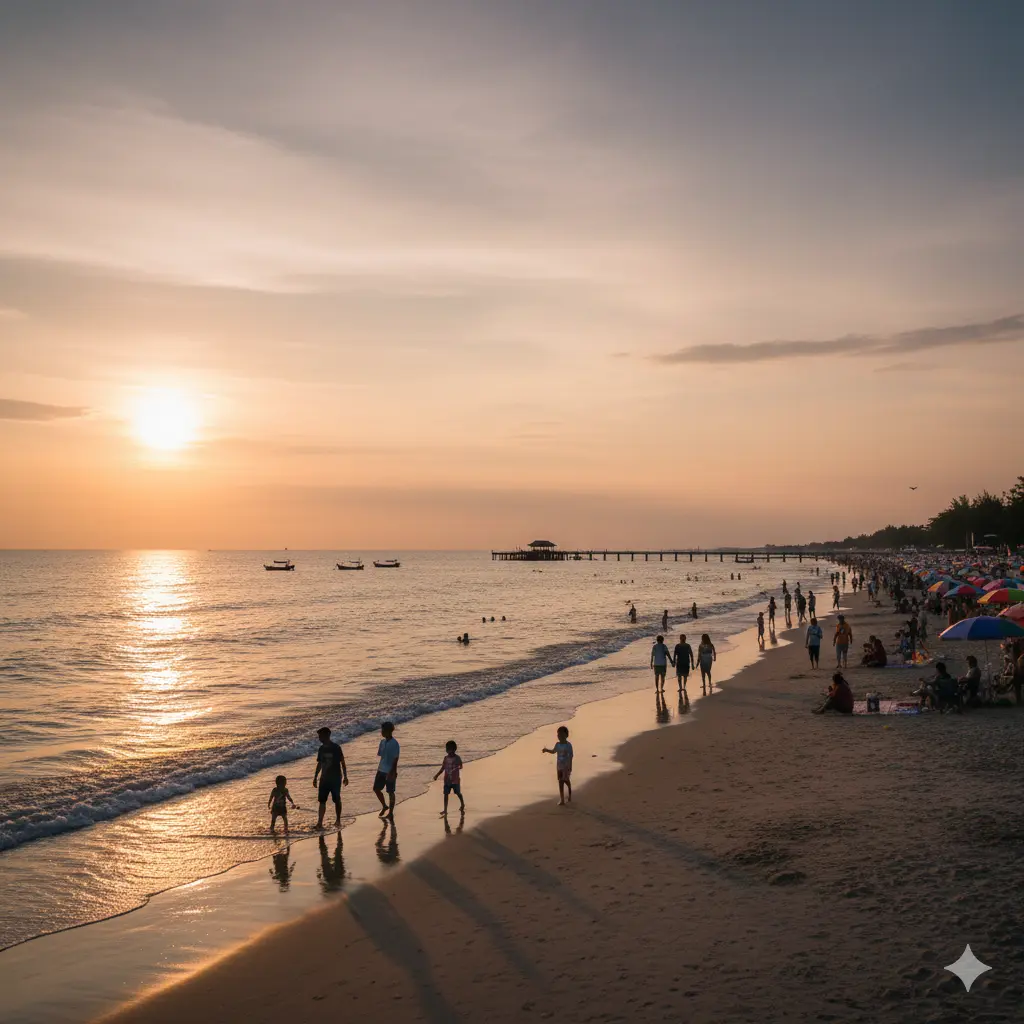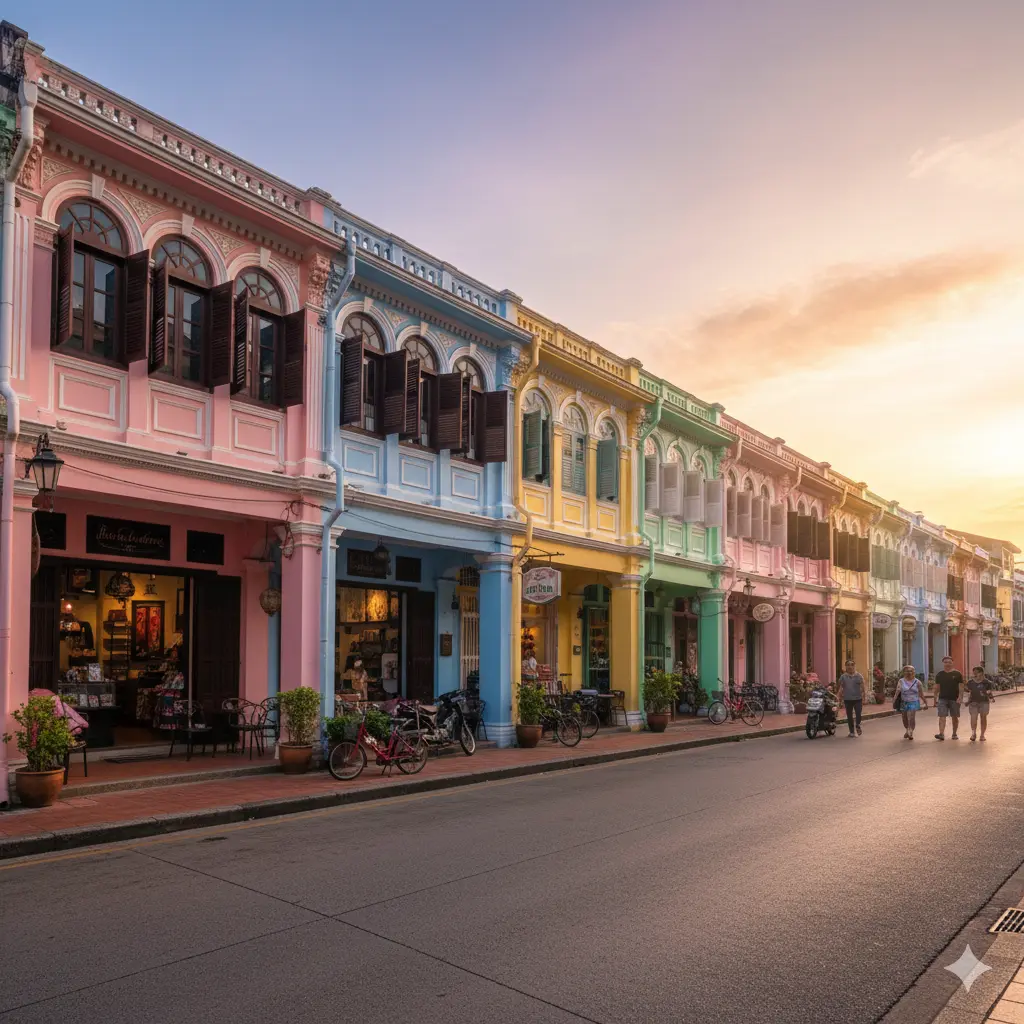
Phuket is often pictured as one long party beach, but the island is far more varied than its reputation. In a single day you can eat a Hokkien-style breakfast in a pastel-painted old town, swim in a quiet bay and watch the sunset from a rocky cape. This guide explains which beach suits you, what to see beyond the sand, what to eat, where to stay and how to plan around the monsoon.
Why visit Phuket
Phuket sits in the Andaman Sea off Thailand’s south-west coast, linked to the mainland by bridges. Its west coast is a string of sandy bays, each with its own character, while the east coast looks out over the island-dotted waters of Phang Nga Bay. The island grew wealthy from tin mining, which drew Hokkien Chinese traders and workers in the 19th century, and their descendants’ Peranakan, or Baba, culture still shapes Phuket Town’s architecture, festivals and food. In 2015, UNESCO named Phuket a Creative City of Gastronomy.
Top things to do in Phuket
Phuket Old Town
The streets around Thalang, Dibuk and Krabi roads are lined with restored Sino-Portuguese shophouses in pastel colours, many now cafés, galleries and small museums. Soi Romanee, a short lane of brightly painted houses, is the most photographed corner. On Sunday evenings, Thalang Road becomes a walking-street market known as Lard Yai, with local snacks, crafts and performances from roughly 4 pm to 10 pm.
Tip: come early in the morning for photos without crowds, then stay for a local breakfast.
The Big Buddha
Seated on Nakkerd Hill between Chalong and Kata, the 45-metre white marble Big Buddha can be seen from much of the south of the island. Entry is free, the site is funded by donations, and the terrace looks out over Chalong Bay and the west coast. Shoulders and knees must be covered; sarongs are lent at the entrance.
Wat Chalong
Phuket’s best-known Buddhist temple is a busy place of worship. Its tall chedi is said to enshrine a relic of the Buddha, and you can climb inside to see murals and the upper balcony. Locals set off firecrackers when a wish has come true, so do not be startled by the bangs.
Promthep Cape
The rocky headland at the island’s southern tip is Phuket’s classic sunset viewpoint, with a lighthouse, a shrine surrounded by elephant figures and views to small offshore islands. It gets very crowded just before sunset, so arrive early or watch from the windmill viewpoint above nearby Ya Nui Beach.
Choosing a beach
- Patong – the busiest beach, with water sports, shopping and the neon of Bangla Road after dark.
- Karon and Kata – long sandy bays with a more relaxed feel, popular with families.
- Kata Noi and Nai Harn – smaller, scenic bays in the south, good for a quiet swim when the sea is calm.
- Kamala and Surin – mid-sized bays north of Patong with resorts and local life.
- Bang Tao – a long beach backed by large resorts.
- Nai Yang and Mai Khao – quiet stretches near the airport, partly within Sirinat National Park.
The Karon Viewpoint, on the coast road south of Kata, takes in three bays in a single view.
Phang Nga Bay by boat or kayak
East of Phuket, dozens of sheer limestone islands rise out of calm green water. Day trips usually combine sea-cave kayaking with Ko Panyi, a Muslim fishing village built on stilts, and Khao Phing Kan, better known as James Bond Island after it appeared in a 1970s Bond film.
The Phi Phi Islands
Although they belong to neighbouring Krabi province, the Phi Phi Islands are a hugely popular day trip from Phuket. Ko Phi Phi Don has a car-free village and a hilltop viewpoint, while uninhabited Ko Phi Phi Le surrounds the famous Maya Bay. Boats no longer enter the bay: visitors land on the far side and walk in along a boardwalk, swimming is not allowed, and the bay closes every year from 1 August to 30 September. Foreign adults pay a 400-baht national park fee.
The Similan Islands
The Similan Islands National Park in Phang Nga province is known for huge granite boulders, white sand and highly regarded diving and snorkelling. It opens only part of the year; the 2026–27 season runs from 15 October to 15 May. Most trips leave from Khao Lak, north of Phuket, with transfers from Phuket hotels.
What to eat in Phuket
- Mee hokkien – thick yellow noodles stir-fried with pork, seafood and greens, a legacy of the island’s Hokkien community.
- O-tao – a savoury fry-up of taro, small oysters and egg, often found at markets.
- Moo hong – pork belly braised with garlic, black pepper and soy sauce until meltingly tender.
- Khanom jeen – a breakfast classic of fresh rice noodles with a choice of curries and a plate of raw vegetables and herbs.
- Dim sum – another breakfast favourite in Phuket Town.
- Southern curries – such as kaeng som, a sour, turmeric-yellow fish curry, and the intensely savoury kaeng tai pla.
Phuket Town is the best place for local food, and the Sunday market is a good introduction. At beach restaurants where you choose seafood by weight, confirm the price before it is cooked.
Where to stay in Phuket
- Patong – nightlife, shopping and a huge choice of hotels; noisy at night.
- Kata and Karon – a good all-rounder for families and first-timers.
- Kamala, Surin and Bang Tao – calmer, with stylish resorts and beach clubs.
- Rawai and Nai Harn – a laid-back south with villas, seafood and easy sunset trips to Promthep Cape.
- Nai Yang and Mai Khao – quiet and close to the airport, ideal for a first or last night.
- Phuket Town – boutique hotels and the best local food, though not on the beach.
Getting there and getting around
Phuket International Airport (HKT) is at the island’s northern tip. Flights from Bangkok take roughly 1 hour 20 to 35 minutes; from the airport, allow around 50 minutes by road to Patong and about an hour to Kata or Rawai. Phuket has no railway: the nearest station is Surat Thani (Phun Phin), followed by a bus ride of several hours. Overnight buses from Bangkok take about 12 to 14 hours, and the drive is roughly 850 km, mostly on Route 4.
There is no metro, so most visitors use taxis, Grab or Bolt. The Phuket Smart Bus runs between the airport and Rawai via several west-coast beaches, and blue local buses link Phuket Town with the main beaches during the day. Roads are hilly and busy, so only rent a scooter if you are licensed, experienced and wearing a helmet.
Best time to visit
The dry season, roughly November to April, brings calm seas, clear water and the most reliable sunshine, with December to February the busiest and priciest period. From about May to October the south-west monsoon brings rain, wind and big waves to the west coast; prices drop and there are sunny spells, but some boat trips are cancelled and swimming can be dangerous. Phuket also celebrates Songkran in April (see our guide to Songkran in Phuket), and the Vegetarian Festival, held in the ninth Chinese lunar month and usually falling around September or October, fills Phuket Town with processions.
Good to know
- Red flags on the beach mean no swimming; rip currents are a real risk on the west coast during the monsoon.
- Thai national parks prohibit sunscreens containing certain chemicals that harm coral, so choose a reef-safe product.
- Carry cash for national park fees and small vendors, and agree taxi fares before setting off or use an app.
- Boat trips depend on the weather; keep a spare day in case of cancellations.
- Krabi is easy to combine with Phuket by ferry or road; see our Krabi travel guide.
In short
Pick your beach to match your mood, spend at least one morning eating your way around Phuket Town and save a calm day for a boat trip to Phang Nga Bay or Phi Phi. Come between November and April for the best seas, and read our short introduction to Phuket, the pearl of the Andaman for more ideas. Flying in via the capital? Our Bangkok travel guide will help you plan a few days there too.