Kanchanaburi, west of Bangkok on the border with Myanmar, packs a remarkable amount into one province: forested hills, turquoise waterfalls, rivers you can sleep on and some of the most moving Second World War sites in Asia. Whether you come for adventure, nature or history, it’s one of the most rewarding trips from the capital.
Erawan Falls: seven tiers of emerald pools
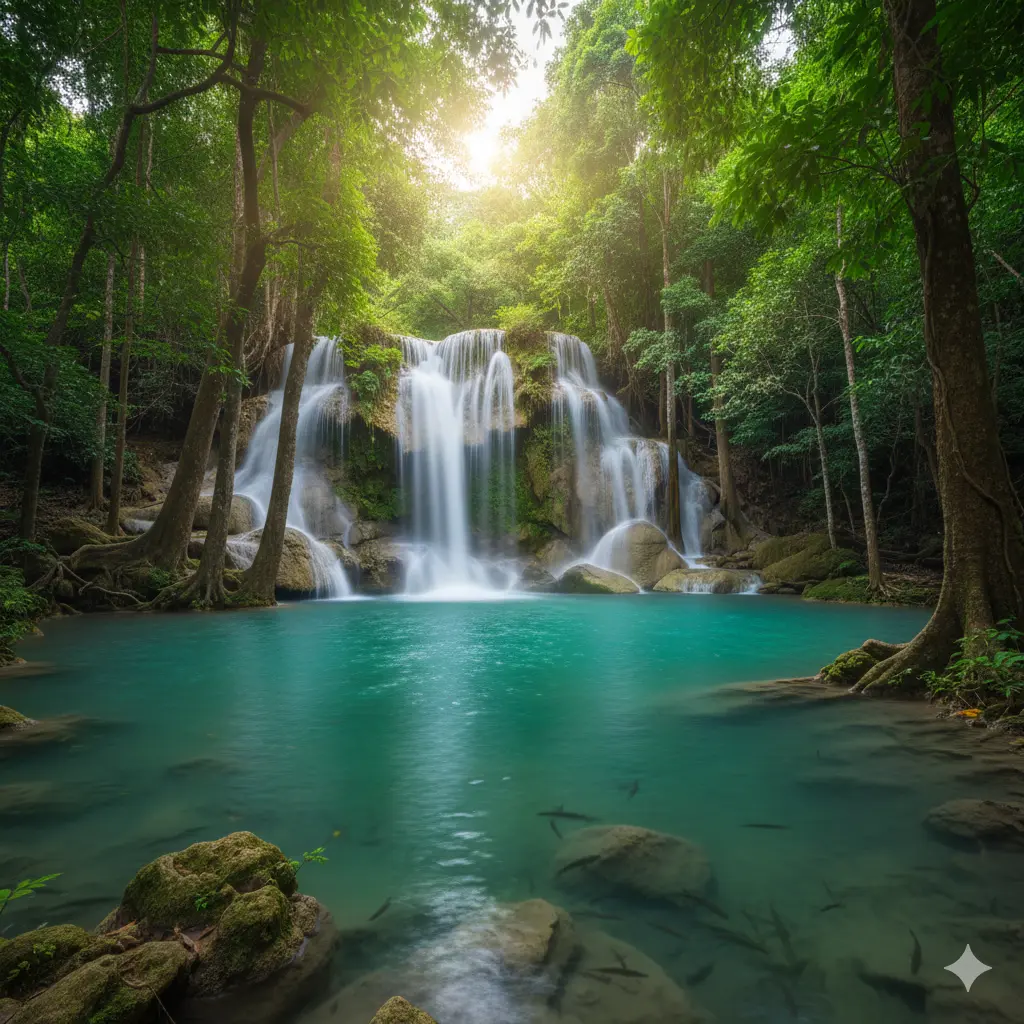
The star of Kanchanaburi’s nature is Erawan Falls, in Erawan National Park in Si Sawat district, about 70 km from Kanchanaburi town. The waterfall drops down seven tiers, each with its own pool, and in sunshine the water glows emerald and turquoise. It takes its name from Erawan, the three-headed elephant of Hindu-Buddhist mythology.
A trail of nearly 1.5 km leads from the lowest tier to the top. The first levels are an easy walk; the upper ones involve steeper paths and some scrambling, so wear shoes with good grip. Swimming is allowed in several pools, but follow the rangers’ instructions and wear a life jacket where required.
The park opens around 8 am and stops admitting visitors in the mid-afternoon, so arrive early to enjoy the pools before the crowds and leave time to reach the top. The dry season (roughly December to April) usually brings calmer, clearer water; after the rains the falls are more powerful but the trail can be slippery.
Life on the water: raft houses and reservoirs
A classic Kanchanaburi experience is a night on a raft house, a simple bungalow built on a floating platform. The best-known area is the Khwae Noi River around Sai Yok, where you can swim off the deck, paddle a kayak at dawn and watch longtail boats chug past. Some rafts can only be reached by boat, and the most rustic have little or no electricity, so bring a torch. At the height of the monsoon, high water can close the simplest rafts.
Further upstream, two huge reservoirs offer a different scene. Srinagarind Dam in Si Sawat district holds back the Khwae Yai, while Vajiralongkorn Dam (formerly Khao Laem Dam) in Thong Pha Phum district blocks the Khwae Noi. Both lakes are ringed by forested hills, and around Vajiralongkorn Dam you can rent sightseeing rafts or stay overnight on floating accommodation.
The Bridge over the River Kwai and the Death Railway
Kanchanaburi’s most famous landmark is the Bridge over the River Kwai. “Kwai” is a Western spelling of Khwae, meaning a tributary: the Khwae Yai (“big tributary”) and the Khwae Noi (“small tributary”) meet in town to form the Mae Klong River.
The bridge was part of the Thailand-Burma Railway, built by the Japanese army in 1942-1943 to link Ban Pong in Thailand with Thanbyuzayat in Burma, about 415 km away. It was built with the forced labour of Allied prisoners of war and far larger numbers of Asian civilian workers. Around 12,000 prisoners and many tens of thousands of Asian labourers died, which is why it became known as the Death Railway.
The steel bridge you see today has curved truss spans that were brought from Java; after Allied bombing in 1945, the damaged spans were replaced with angular sections supplied by Japan after the war. Trains still run on part of the Thai section of the line, as far as Nam Tok, so you can ride a stretch of this history yourself. To understand the human cost, visit the Allied war cemetery in town and, further up the valley, Hellfire Pass, the railway’s largest rock cutting, which has a memorial museum.
Kanchanaburi Skywalk
For a modern view of the rivers, head to the Kanchanaburi Skywalk (also known as the Song Khwae Mae Klong Skywalk) on the bank of the Khwae Yai in the town district. Opened in 2022, this glass skywalk is about 150 m long and around 12 m high, looking out over the point where the two rivers meet; on a clear day you can see their waters in slightly different colours.
Planning your trip
Kanchanaburi is a few hours west of Bangkok by road, and trains also run from the capital. The town is a good base for the bridge, the war sites and the skywalk, but Erawan, Sai Yok and the reservoirs are far apart, so allow at least two or three days if you want to combine history and nature. A rental car or day tour saves time. Neighbouring Ratchaburi pairs well with Kanchanaburi, and our Kanchanaburi province guide covers more places to see and stay.
Good to know
- Best for: adventure, nature and Second World War history
- Don’t miss: Erawan Falls, the Bridge over the River Kwai and a night on a raft house
- Erawan: arrive early, as entry stops in the mid-afternoon; wear shoes with grip
- National park fees: foreign visitors pay a higher rate than Thais, so carry cash
- War sites: dress and behave respectfully at cemeteries and memorials
- Raft houses: pack a torch, insect repellent and a dry bag
- Best season: about November to February for cooler days; December to April for clearer waterfall pools
In short
Kanchanaburi combines big nature with a powerful history lesson. Swim beneath Erawan’s tiers, fall asleep to the sound of the river on a raft house and take time at the Death Railway sites. If history is your main interest, our guide to Ayutthaya, the old capital makes a good next stop.