Kanchanaburi is Thailand’s big western province, running from the farmland a couple of hours outside Bangkok all the way to the forested mountains on the Myanmar border. Many visitors know it for a single bridge, but that is only the beginning. Beyond the riverside town lie tiered waterfalls, vast reservoirs, floating raft houses and quiet border communities, all tied together by a railway with a painful history.
Why visit Kanchanaburi
During the Second World War, the Japanese army forced Allied prisoners of war and tens of thousands of Asian labourers to build a railway from Thailand into Burma. Many thousands died from overwork, disease and malnutrition, and the line became known as the Death Railway. Kanchanaburi’s museums, cemeteries and the railway itself tell that story with care.
The province is also one of the best places near Bangkok for nature, with national parks full of forests, caves and waterfalls, and rivers lined with raft houses. Since the M81 motorway opened to tolled traffic in January 2026, even a weekend trip is easy. For a shorter overview, see our guide to adventure and nature in Kanchanaburi.
Top things to do in Kanchanaburi
The Bridge over the River Kwai
The steel bridge on the edge of town was built in 1943 as part of the Death Railway. Allied bombing damaged it in 1945; the curved truss spans you see today are originals, while the two straight-sided middle spans were replacements fitted after the war. You can walk across at any time free of charge, and trains still use it several times a day, so step into the small side platforms when one approaches. Early morning and early evening are calmer and cooler.
Kanchanaburi War Cemetery and the Thailand–Burma Railway Centre
In the middle of town, the immaculate Kanchanaburi War Cemetery holds around 7,000 graves, mostly of British, Australian and Dutch prisoners, and is maintained by the Commonwealth War Graves Commission. Visit the Thailand–Burma Railway Centre next door first: its displays explain how the line was built and what life was like in the camps, which makes the cemetery even more affecting.
Ride the Death Railway to Tham Krasae and Nam Tok
The remaining section of the line still carries passenger trains from Kanchanaburi to Nam Tok station. The highlight is the Tham Krasae viaduct, a wooden trestle that clings to a cliff above the Khwae Noi River, where trains slow to walking pace. There is a small cave shrine beside the tracks if you get off at Tham Krasae. From Nam Tok, songthaews (shared pick-up taxis) run to Sai Yok Noi waterfall nearby. Services are limited, so check the return times before you set off.
Hellfire Pass Interpretive Centre
About 80 km northwest of town, Hellfire Pass is a deep rock cutting that prisoners dug largely by hand. The interpretive centre, run by the Australian government, has thoughtful exhibits and is free to enter. It opens daily from 09:00 to 16:00 but closes on certain dates, including Songkran and part of May. A short trail leads to the cutting and a longer one follows the old railway bed; allow two to three hours.
Erawan Falls
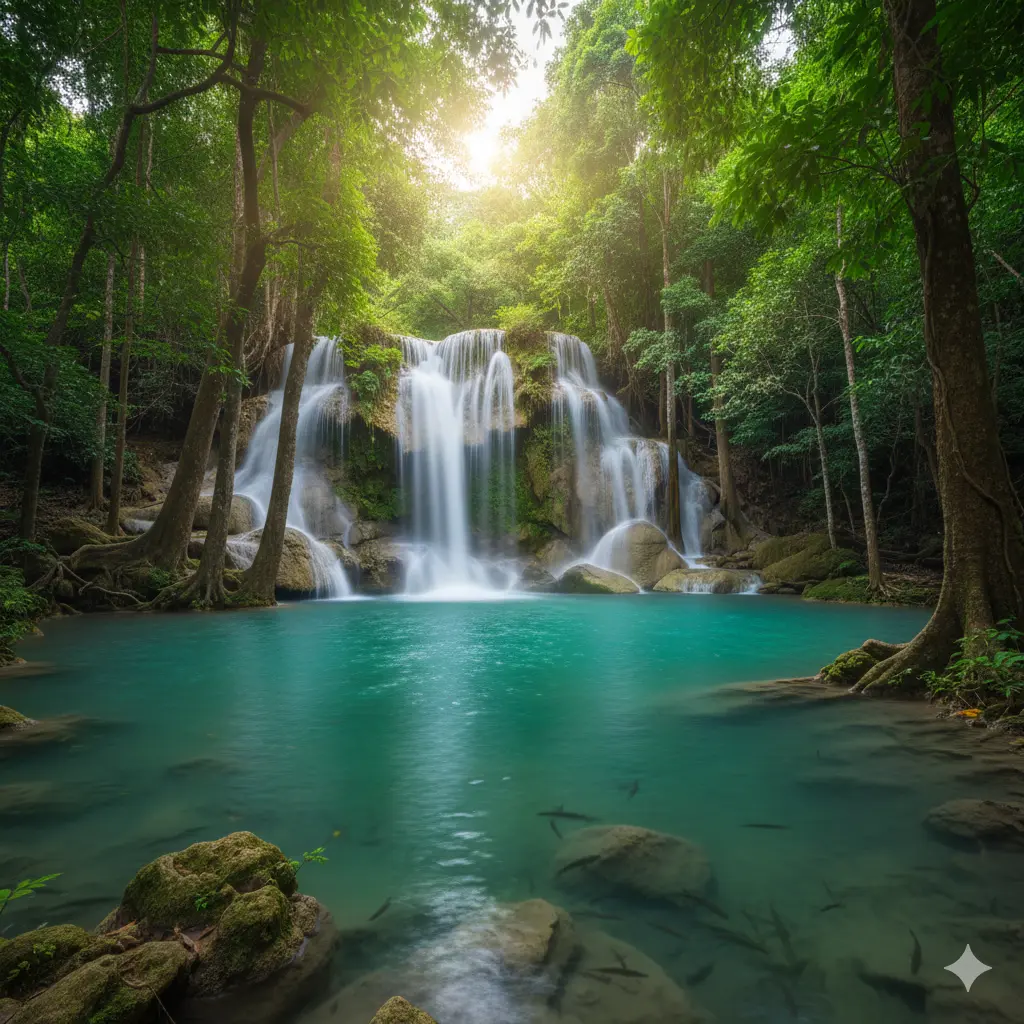
Erawan National Park, about 70 km from town, is famous for a waterfall that tumbles over seven main tiers into turquoise pools where small fish nibble at your feet. The park opens from 08:00 to around 16:30, and entry is not allowed after 15:30. At the time of writing the fee is 300 baht for foreign adults and 60 baht for Thai adults. Food is not allowed beyond the second tier, and plastic drink bottles carry a small refundable deposit. Arrive early if you want to reach the upper tiers before the crowds, and wear shoes with good grip.
Sai Yok and the raft houses
Further up the Khwae Noi valley, Sai Yok National Park is known for Sai Yok Noi, a roadside waterfall that is at its best in the rainy season and can slow to a trickle by the end of the dry months. The river here is lined with floating raft-house resorts, where you can swim, kayak and fall asleep to the sound of water. Wear the life jackets provided: the current can be stronger than it looks.
Kanchanaburi Skywalk
On the town’s riverside, a 150-metre walkway rises 12 metres above the point where the Khwae Noi and Khwae Yai join to form the Mae Klong River. Part of the floor is glass, and visitors wear cloth covers over their shoes. It is generally open from morning until late afternoon, and the view is best close to sunset.
Sangkhla Buri
Near the Myanmar border in the far northwest, Sangkhla Buri sits beside a vast reservoir. Its long wooden Mon Bridge links the town with a Mon village; part of it collapsed in floods in 2013 and reopened after rebuilding in 2014. Monks often cross it at dawn to collect alms, and when the water is low the ruins of a temple submerged by the reservoir re-emerge. It is a long drive, so stay at least one night.
Local food to try
With so many rivers, Kanchanaburi’s cooking leans towards freshwater fish: steamed with lime and chilli, deep-fried and topped with crisp herbs, or cooked in spicy, sour soups. Riverside and floating restaurants are the classic places to eat it, ideally at sunset. Jungle curry (kaeng pa), a fiery coconut-free curry with fresh herbs, is also common.
Popular things to take home include crisp rolled wafers (thong muan), tamarind sweets, chilli pastes and, from the province’s gem-mining past, jewellery set with black onyx and blue sapphire – bought for pleasure, not as an investment.
Where to stay
- Kanchanaburi town, near the bridge: riverside guesthouses and mid-range hotels along Mae Nam Khwae Road put you close to the bridge, the cemetery and the station. This is the easiest base without a car.
- Raft houses on the Khwae Noi: around Sai Yok and Tham Krasae. Atmospheric and relaxing, though some get lively with karaoke on weekends; ask before booking if you want quiet.
- Si Nakharin reservoir: floating bungalows and lakeside resorts for a slower stay with your own transport.
- Sangkhla Buri: guesthouses and small resorts overlooking the reservoir, best for an overnight stop.
Getting there and getting around
By car: Kanchanaburi town is about 125–130 km from central Bangkok. Using the M81 motorway, the drive takes around two hours, depending on traffic leaving the city; tolls apply.
By bus or minivan: buses leave Bangkok’s Southern Bus Terminal (Sai Tai Mai) frequently throughout the day and take around two hours; minivans also run from Bangkok.
By train: two ordinary trains a day leave Thon Buri station in Bangkok for Kanchanaburi, taking roughly two and three-quarter hours, and the line continues on to Nam Tok. The ride is slow but scenic. Special excursion trains sometimes run on weekends and holidays; check the State Railway of Thailand’s schedule.
Getting around: in town, bicycles, scooters and songthaews cover short hops; for Erawan, Hellfire Pass and Sai Yok you will need a rental car, a driver, a local bus or a tour.
Best time to visit
The cool season from November to February is the most comfortable for sightseeing and hiking. March to May is hot, and some waterfalls run low. The rainy season from June to October fills the waterfalls and turns the hills green, though trails can be slippery and river levels high. The River Kwai Bridge Week festival is usually held from late November into early December, with an evening light-and-sound show at the bridge and a Red Cross fair; check the dates each year.
Good to know
- Treat the war sites as memorials: dress respectfully and keep your voice down in the cemeteries.
- National parks charge separate entry fees for foreign visitors and Thais; carry cash.
- Distances are long. Erawan and Hellfire Pass are each more than an hour from town, so do not try to fit everything into one day.
- Rivers and waterfall pools can have strong currents, especially in the rainy season. Swim only where it is permitted.
- Bring insect repellent for forests and riverside evenings.
In short
Kanchanaburi combines sobering history with some of the most accessible nature near Bangkok. Spend a day on the bridge, the museums and the railway, then head upriver for waterfalls and a night on a raft. It pairs well with Ayutthaya for a history-themed week, or as an easy escape from Bangkok.