Nan is a quiet, green valley province on Thailand’s border with Laos, once a semi-independent kingdom and still one of the most unhurried places in the north. Its old town holds some of the finest temple murals in the country, Tai Lue villages keep weaving traditions alive, and the mountains of Doi Phu Kha rise to the east. In 2025 UNESCO named Nan a Creative City of Crafts and Folk Art, recognising its textiles, bamboo work and ancient pottery. Come for culture, cycling and cool mountain air rather than nightlife.
- Best for: culture lovers, cyclists, photographers, slow travellers
- From Bangkok: about 670 km; roughly 10 hours by road, or a little over an hour’s flight to Nan Nakhon Airport
- Best time: November–February for cool weather; October–November for the boat races
- Don’t miss: Wat Phumin murals, Wat Phra That Chae Haeng, Bo Kluea salt wells
Getting there and getting around
Nan Nakhon Airport has direct flights from Bangkok’s Don Mueang, and the airport is only a few minutes from the old town. Long-distance buses run from Bangkok’s Mo Chit and from Chiang Mai via Phrae. The old town is compact and flat — perfect on foot or by bicycle, which many guesthouses lend or rent. For Doi Phu Kha, Bo Kluea, Pua or Sapan you will need a car or motorbike; the mountain roads are steep and winding, so allow plenty of time.
Top things to do in Nan
1. Wat Phumin
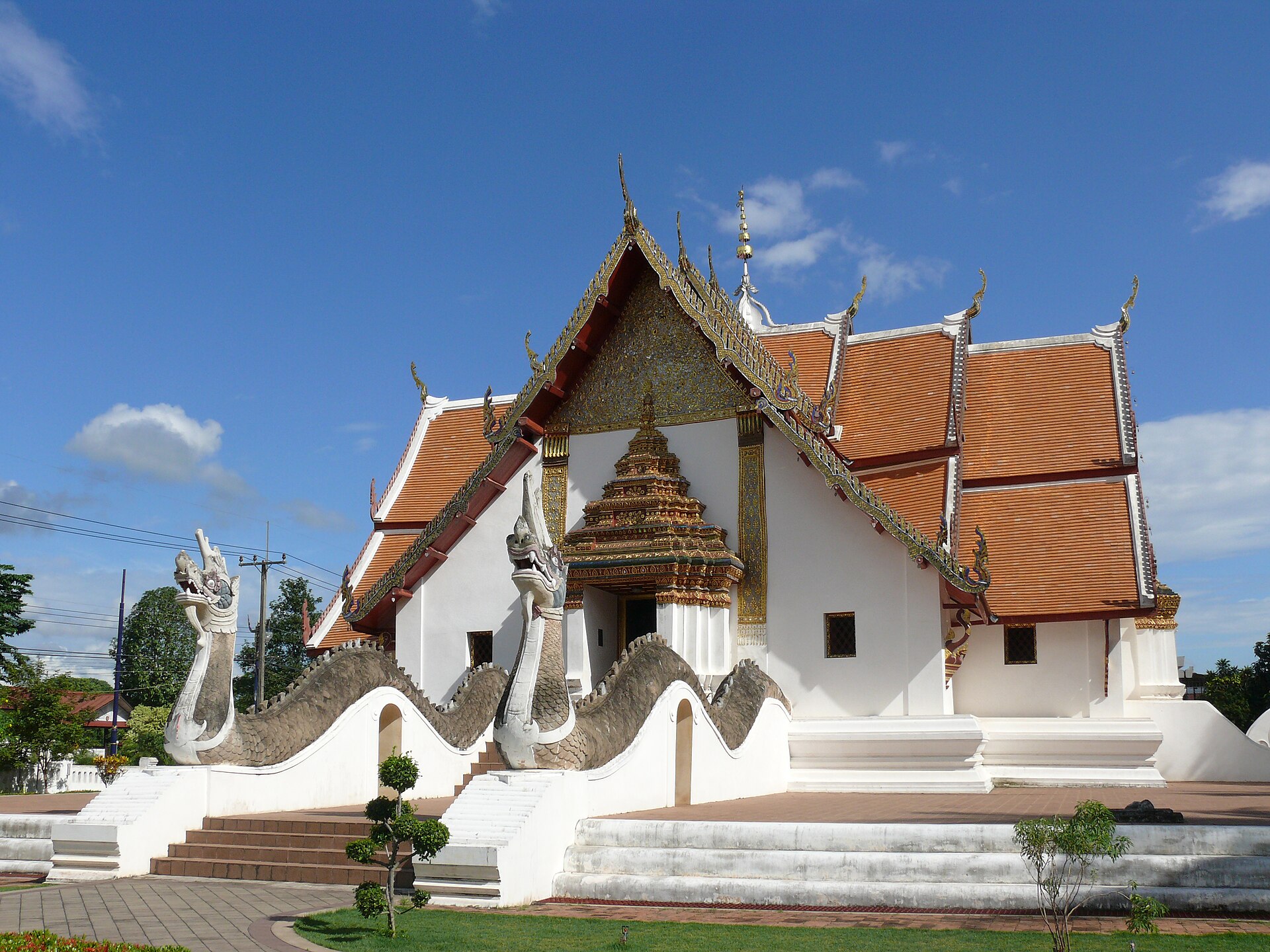
Nan’s most famous temple has a cross-shaped hall with four entrances guarded by nagas, and inside, murals painted in the late 19th century showing daily life, Tai Lue costume and Buddhist tales. Look for the much-loved couple known as Pu Man Ya Man, often called “the whispering lovers”. Map
2. Nan National Museum
Across the road from Wat Phumin, the former palace of Nan’s rulers tells the story of the old kingdom and its peoples, and is known for a revered black elephant tusk. Map
3. Wat Phra That Chang Kham
Beside the museum, this temple’s chedi is supported by elephant sculptures at its base — an easy stop on an old-town walk. Map
4. Wat Phra That Chae Haeng
Across the Nan River just outside town, a golden chedi stands on a low hill approached by a staircase lined with nagas. It is one of the province’s most sacred sites and lovely in late-afternoon light. Map
5. Wat Phra That Khao Noi
A hilltop temple with a large standing Buddha overlooking the town — the classic sunset viewpoint over Nan. Map
6. Wat Si Panton
A newer temple in the old town covered in gold and red Lanna-style decoration, with nagas twisting along the roof edges. Map
7. Doi Phu Kha National Park
Mountain forests, waterfalls and viewpoints in the east of the province. The park is famous for the rare Chomphu Phu Kha tree, whose pink blossoms usually appear around January–February. Map
8. Bo Kluea salt wells
In a mountain valley far from the sea, villagers still draw salty water from ancient wells and boil it into salt. You can watch the process and buy small bags as souvenirs. Map
9. Sapan village
A small mountain village beside a clear stream, with homestays, rice terraces and cafés — a peaceful overnight stop combined with Bo Kluea. Map
10. Wat Nong Bua and Tai Lue villages
In Tha Wang Pha district, Wat Nong Bua is a Tai Lue temple with murals related in style to Wat Phumin, and nearby villages sell handwoven Tai Lue textiles. Map
11. Khun Nan viewpoint
In the far north of the province, this mountain viewpoint looks over terraced fields and ridges towards Laos; mornings in the cool season can bring mist. Map
Suggested two-day itinerary
Day 1: Morning at Wat Phumin, the National Museum and Wat Phra That Chang Kham; lunch in the old town; afternoon cycle to Wat Si Panton and across the river to Wat Phra That Chae Haeng; sunset at Wat Phra That Khao Noi and dinner at the walking street if it is a weekend. Day 2: Drive to Wat Nong Bua and a Tai Lue weaving village, continue up into the mountains to the Bo Kluea salt wells, and finish at Sapan or overnight in the hills before returning via Doi Phu Kha.
Festivals and events in Nan
Nan boat races, around October–November: long, carved boats with dragon-head prows race on the Nan River after the end of Buddhist Lent, accompanied by merit-making and the kathin season. Kad Khuang Mueang Nan walking street: weekend evenings in front of Wat Phumin bring food stalls, crafts and locals eating on mats on the lawn. Songkran (13–15 April): celebrated in Lanna style with temple rituals and water play; see our Songkran in Chiang Mai guide for northern traditions and our Songkran etiquette guide. Craft festivals linked to Nan’s UNESCO status are also held through the year. Dates vary — check with TAT.
Travel tips
- Dress modestly at temples; Wat Phumin and Chae Haeng are active places of worship.
- Mountain roads to Bo Kluea and Doi Phu Kha are steep with sharp bends — drive slowly and avoid night driving.
- Accommodation in the hills is limited on cool-season holidays; book ahead.
- Buy textiles directly from weaving groups to support local makers.
FAQ
How many days do I need in Nan?
One day covers the old town; two to three days lets you add Bo Kluea, Tai Lue villages and the mountains.
What is Nan famous for?
The murals at Wat Phumin, Tai Lue weaving, mountain scenery and its UNESCO Creative City status for crafts and folk art.
Do I need a car in Nan?
Not for the old town, which is easy by bicycle; for the mountains a car, motorbike or hired driver is best.
When are the Nan boat races?
Usually around October–November after the end of Buddhist Lent; exact dates are announced each year.
Keep exploring
Cover photo: Wat Phumin devant, Nan.jpg · (WT-fr) Ellnik at French Wikivoyage · CC BY-SA 1.0 · Wikimedia Commons