Ayutthaya is only about an hour north of Bangkok, yet arriving here feels like stepping back several centuries. For roughly four hundred years this river island was the capital of the Siamese kingdom and a trading city that drew merchants from China, Japan, Persia and Europe. After it fell to a Burmese army in 1767, its surviving brick towers and Buddha images were left standing among what are now ordinary streets, markets and noodle stalls – a mix of grand ruins and everyday life that makes the city a joy to explore.
Why visit Ayutthaya
The old city occupies an island ringed by the Chao Phraya, Pa Sak and Lopburi rivers. Its ruins were added to the UNESCO World Heritage List as the Historic City of Ayutthaya in 1991, but this is no fenced-off archaeological zone: the historical park is woven into the modern town, so you can cycle from a centuries-old prang (a tall, corn-cob-shaped tower) to a coffee shop in a few minutes.
A day trip from the capital works if you start early, but one night is better: you get soft morning light, cooler air for cycling and quiet evenings after the tour buses leave. Short on time? Our one-day route through the old capital covers the essentials, and Ayutthaya pairs naturally with a few days in Bangkok.
Top things to do in Ayutthaya
Wat Mahathat
This is the temple behind Ayutthaya’s most famous image: a sandstone Buddha head slowly enclosed by the roots of a fig tree. Around it lie rows of headless Buddhas and the base of what was once one of the city’s grandest towers. The head is still treated as sacred, so if you want a photo, crouch or kneel so that your own head stays lower than the Buddha’s – staff will remind you if you forget.
Wat Ratchaburana
Across the road from Wat Mahathat, Wat Ratchaburana has one of the city’s best-preserved prangs, decorated with stucco garudas and mythical creatures. Steep steps lead up into the tower and down into a small crypt with faded murals; the gold found here is now in the Chao Sam Phraya National Museum.
Wat Phra Si Sanphet and Wihan Phra Mongkhon Bophit
The three bell-shaped chedis standing in a row at Wat Phra Si Sanphet are the classic Ayutthaya postcard. This was the royal temple inside the old palace grounds, used for state ceremonies rather than as a monastery. Next door, the Wihan Phra Mongkhon Bophit houses a huge bronze seated Buddha and is an active place of worship that you can enter free of charge.
Wat Chaiwatthanaram
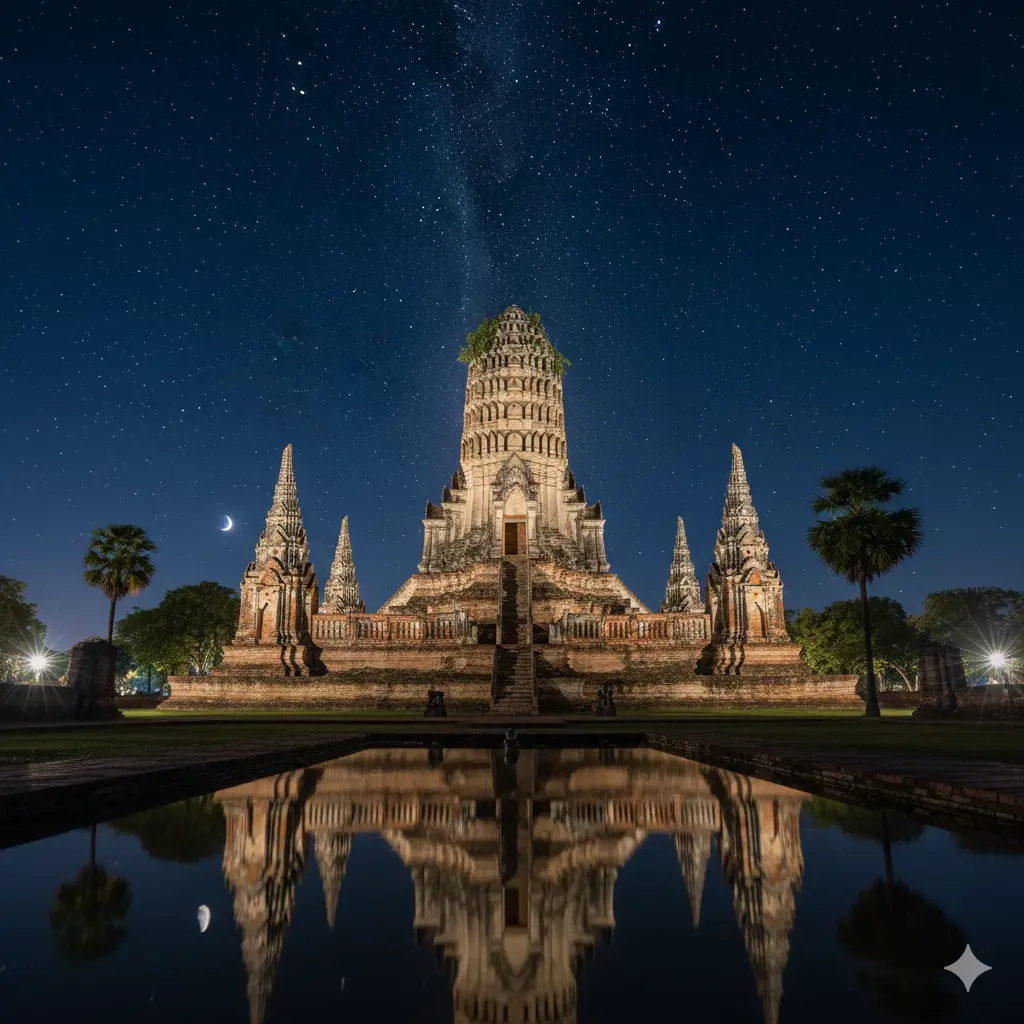
Set on the west bank of the Chao Phraya, just outside the island, Wat Chaiwatthanaram was built in the 17th century in a Khmer-inspired layout: a tall central prang surrounded by smaller towers and a gallery of seated Buddhas. It is the best place in Ayutthaya for late-afternoon light, and you will often see visitors in rented traditional Thai costume posing for photos. Cross the bridge by bike or tuk-tuk and arrive an hour before sunset.
Wat Yai Chai Mongkhon
Southeast of the island, this working monastery is known for its massive climbable chedi, a long line of saffron-draped Buddha images and a white reclining Buddha. It draws many Thai worshippers, especially on weekends, so dress respectfully.
Wat Phanan Choeng
Where the Chao Phraya and Pa Sak rivers meet, Wat Phanan Choeng shelters a gilded seated Buddha about 19 metres tall. According to local historians it was made in 1324, about a quarter of a century before Ayutthaya was founded. Thai-Chinese devotees know it as Sam Po Kong, and the hall is often thick with incense and offerings.
Chao Sam Phraya National Museum
When the midday heat becomes too much, retreat to this museum near the historical park. Its gold regalia, jewellery and votive objects from temple crypts show just how wealthy the kingdom once was.
Bang Pa-In Royal Palace
South of the city, Bang Pa-In is a royal summer palace with Thai, Chinese and European-style buildings set around ornamental lakes. It is generally open from 08:00 to 16:00, but it can close for royal occasions, so check before you go. The dress code is strictly enforced: no sleeveless tops, short skirts or shorts. The grounds are large, and many visitors rent a golf cart.
Local food to try
Ayutthaya’s best-known splurge is kung mae nam phao, grilled giant river prawns, served with the rich orange fat from the head spooned over rice and a sharp chilli-lime dipping sauce. Riverside restaurants sell them by weight, so ask the price per kilo before you order.
For something quicker, look for kuay teow reua (boat noodles): small bowls of noodles in a dark, aromatic broth, cheap enough to order two or three at a time. Ayutthaya is also the home of roti sai mai, thin roti sheets that you wrap around strands of pastel-coloured spun sugar. It is sold at stalls around town and is the classic edible souvenir to take home.
Evening markets around the old city sell grilled meats, som tam (green papaya salad) and Thai desserts. The Ayothaya Floating Market is a modern, tourist-oriented market built over water: fun for snacks, but not a traditional working market.
Where to stay
- On the island, near the historical park: the most convenient base if you want to walk or cycle between temples. Expect guesthouses and small boutique hotels on quiet side streets.
- By the river: hotels along the rivers that ring the island trade a little convenience for views of passing boats and illuminated temples, and are well suited to a slower overnight stay.
- Near the train station: the station sits on the east bank of the Pa Sak River, a short ferry hop or tuk-tuk ride from the island. Budget guesthouses here are handy if you are arriving late or leaving early.
Getting there and getting around
By train: many northbound trains stop at Ayutthaya. Since 1 August 2026 the State Railway of Thailand has also run an air-conditioned commuter service, SRT Bangkok Connex, from Krung Thep Aphiwat Central Terminal, with several departures a day and a journey of just over an hour. At launch, tickets were sold only at stations and seats were unreserved.
By road: the drive from central Bangkok covers about 80 km and usually takes one to one and a half hours, depending on traffic. Minivans also run from Bangkok’s northern side.
Around town: a rented bicycle is the classic way to see the historical park, as the main ruins are within a few kilometres of each other. Tuk-tuks can be hired by the hour, and are the easier option for the temples off the island.
Best time to visit
The cool, dry months from November to February are the most comfortable for cycling and temple-hopping. From March to May the heat is intense, so start at 08:00, rest indoors at midday and return to the ruins for sunset. The rainy season from June to October brings greener scenery and fewer visitors, but the rivers can rise towards the end of the season, so check local news if you travel in September or October.
Loy Krathong, usually in November, is celebrated beautifully along the rivers. In December the province usually holds a World Heritage fair in the historical park to mark the anniversary of the UNESCO listing, with light shows and performances; dates are announced each year.
Good to know
- The main temples in the historical park each charge a small entry fee – around 80 baht for foreign visitors and 10 baht for Thais at the time of writing – and a combined ticket for several sites is usually available. Carry cash.
- Cover your shoulders and knees at active temples and at Bang Pa-In Palace.
- Do not climb on ruins or Buddha images, and avoid posing in ways that could be seen as disrespectful.
- Shade is limited: bring water, a hat and sunscreen, and plan the hottest hours around museums and lunch.
- Agree on tuk-tuk fares before you get in, ideally an hourly rate with a clear list of stops.
In short
Ayutthaya rewards anyone with even a passing interest in history. Cycle the island’s ruins in the morning, eat river prawns for lunch, catch the sunset at Wat Chaiwatthanaram and, if you can, stay the night. When you are ready to move on, Kanchanaburi to the west makes a good next stop for rivers, waterfalls and wartime history.