Chiang Mai is where many travellers finally slow down. After Bangkok, the pace is gentler, the evenings are cooler for part of the year and the mountains are always on the horizon. The city mixes centuries-old temples with independent cafés, craft workshops and distinctive northern food, and it makes an easy base for trips into the hills.
Why visit Chiang Mai
King Mangrai founded Chiang Mai in 1296 as the capital of the Lanna kingdom, and the heart of the city still follows his plan: a square old town ringed by a moat and brick walls. Inside are dozens of temples in the northern Lanna style, with sweeping tiered roofs, carved wooden gables and gilded chedis. Lanna culture shows up everywhere, from the local dialect and textiles to the food, so the north feels noticeably different from central Thailand.
Top things to do in Chiang Mai
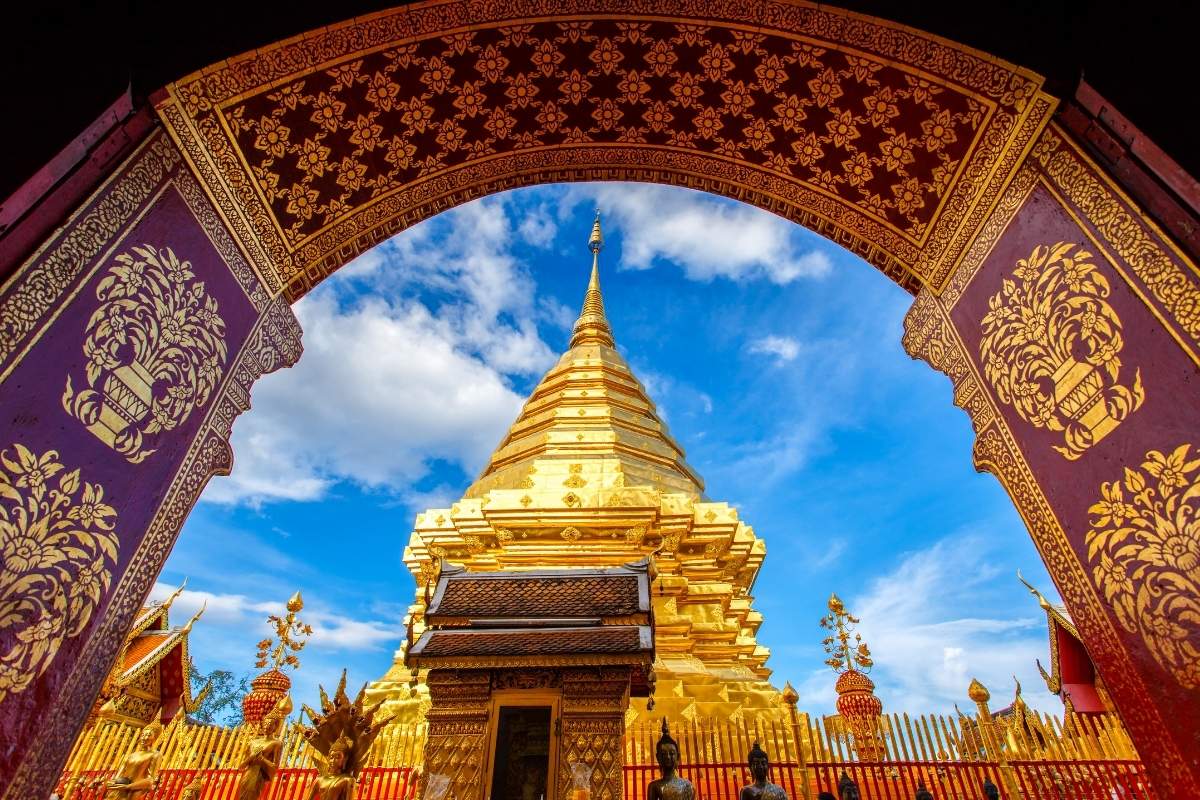
Wat Phra That Doi Suthep
Chiang Mai’s most important landmark sits at about 1,073 metres on the mountain west of the city. A staircase of 306 steps, flanked by naga (mythical serpent) balustrades, climbs to a courtyard centred on a gleaming golden chedi; a funicular runs alongside if you would rather not climb. Foreign visitors pay a small entry fee, currently 30 baht.
Tip: go early, when the air is clearer and the tour groups have not arrived. Shared red trucks run up the mountain from near Chang Phueak Gate; agree the fare first.
The old city temples
Walking or cycling between the temples inside the moat is one of Chiang Mai’s simple pleasures. Three stand out:
- Wat Chedi Luang – a massive brick chedi, partly ruined for centuries, that still dominates the old city.
- Wat Phra Singh – home of the revered Phra Buddha Sihing image and a fine example of Lanna temple buildings.
- Wat Chiang Man – traditionally regarded as the city’s oldest temple, with a chedi supported by stucco elephants.
Our article on Chiang Mai’s old city suggests a relaxed route around the moat.
The Sunday and Saturday walking streets
Every Sunday evening, Ratchadamnoen Road, running from Tha Phae Gate into the heart of the old city, closes to traffic and fills with stalls selling handicrafts, textiles, art and snacks. On Saturday evenings, Wua Lai Road, near Chiang Mai Gate, hosts a smaller market in the city’s traditional silversmithing quarter. Both start in the late afternoon and are busiest from about 6 pm to 8 pm; temple grounds along the way turn into open-air food courts.
Nimmanhaemin and Wat Umong
West of the old city, Nimmanhaemin Road and its side lanes are the place for specialty coffee, design shops and casual restaurants. A short ride away, Wat Umong is a peaceful forest temple known for its old brick tunnels, and the small artists’ village of Baan Kang Wat sells ceramics, prints and handmade goods.
Doi Inthanon National Park
Doi Inthanon is Thailand’s highest mountain at 2,565 metres and makes a full-day trip south-west of the city. Highlights include the boardwalk through moss-covered cloud forest near the summit, the twin royal pagodas built for the 60th birthdays of King Bhumibol and Queen Sirikit, and waterfalls such as Wachirathan. The Kew Mae Pan nature trail, a ridge walk with sweeping views, closes every year from June to October and reopens on 1 November; walkers must go with a local guide hired at the trailhead. Foreign adults currently pay a 300-baht park fee, and the pagodas charge separately.
Tip: on the coldest mornings of the cool season, temperatures near the summit can drop close to freezing, so bring a warm layer.
An ethical elephant experience
If you want to see elephants, choose a sanctuary where visitors observe, feed or walk alongside the animals rather than ride them or watch shows, and read recent reviews before you book.
Warorot Market
Known locally as Kad Luang, “the big market”, Warorot near the Ping River is the easiest place to buy edible souvenirs such as sai ua sausage, nam prik noom chilli dip and crispy pork rinds. The flower market by the river next door is liveliest early in the morning.
Craft villages and mountain escapes
East of the city, Bo Sang is known for hand-painted umbrellas, and the road through San Kamphaeng passes silk and craft workshops. Further into the hills, Mae Kampong is a village of wooden houses, coffee gardens and homestays, roughly an hour’s drive from town.
What to eat in Chiang Mai
Northern Thai food is earthier and often less sweet than central Thai cooking, with plenty of herbs, grilled meats and sticky rice. Look for:
- Khao soi – egg noodles in a rich coconut curry broth, topped with crispy noodles and served with pickled greens, shallots and lime.
- Sai ua – a coarse, herb-packed pork sausage grilled over charcoal.
- Nam prik noom and nam prik ong – a smoky green-chilli dip and a mild tomato-and-pork relish, eaten with vegetables and crispy pork rinds.
- Kaeng hang le – a slow-cooked pork curry with Burmese influences, tangy rather than fiery.
- Khanom jeen nam ngiao – rice noodles in a tomato-based pork broth, a northern breakfast favourite.
Markets and walking streets are the cheapest way to try several dishes. For a cultural evening, a khantoke dinner serves northern dishes on a low pedestal tray, often with traditional dance.
Where to stay in Chiang Mai
- Old City – walkable and full of temples, guesthouses and small hotels; ideal for first-timers.
- Nimmanhaemin – modern hotels near cafés and shopping malls, lively in the evening.
- Night Bazaar and the riverside – handy for night markets and riverside restaurants.
- Santitham – a local neighbourhood north of the moat with good-value rooms and street food.
- Mae Rim and Hang Dong – resorts and villas in greener surroundings; best with a car.
Getting there and getting around
Flights from Bangkok take about 70 to 80 minutes, and the airport is only 10 to 15 minutes by car from the old city. The overnight sleeper train from Bangkok’s Krung Thep Aphiwat Central Terminal is an experience in itself; allow 12 to 14 hours, as delays are common. Buses from Mo Chit terminal take roughly 9 to 12 hours, and the drive is about 700 km via Highways 1 and 11.
In town, the red shared trucks called rot daeng go almost anywhere; agree the fare before you get in. Grab and Bolt work well, and a bicycle is enough for the old city. Only rent a scooter if you hold a valid motorcycle licence, wear a helmet and are confident on steep mountain roads.
Best time to visit
The cool, dry months from November to February are the most pleasant, with sunny days and chilly nights in the hills. November usually brings the Yi Peng and Loy Krathong festivals, when lanterns and candlelit floats light up the city. From around February to April, smoke from agricultural and forest fires can cause heavy haze, often worst in March and April, so check air-quality readings if you have breathing problems. April is also the hottest month and the time of Songkran, when the moat becomes the centre of a city-wide water fight; see our guide to Songkran in Chiang Mai. The rainy season, roughly June to October, turns the countryside green, though some trails close.
Good to know
- Pack a fleece or light jacket for early mornings in the mountains between December and February.
- Release sky lanterns only at organised events that have permission; restrictions apply, especially near the airport flight path.
- Dress modestly at temples and remove your shoes before entering halls.
- Mountain roads are steep and winding; if you get car sick, sit in the front and travel in daylight.
- For a longer northern loop, continue to Pai and the mountains of Mae Hong Son, around three hours away on a winding road.
In short
Give Chiang Mai at least three days: one for the old city and Doi Suthep, one for a mountain trip such as Doi Inthanon, and one for markets, cafés and craft villages. Come in the cool season if you can, watch the haze in spring, and pair it with a few days in Bangkok for a classic first trip to Thailand.