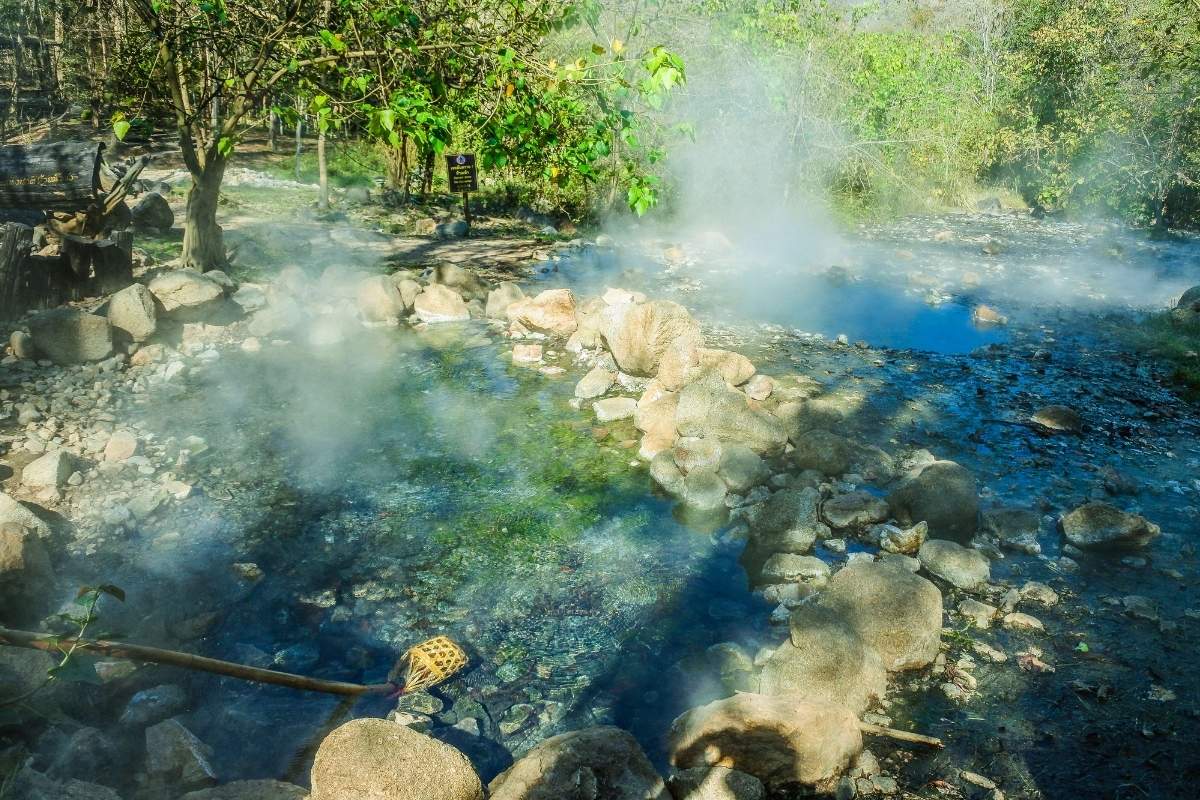
Tucked against the Myanmar border in Thailand’s far northwest, Mae Hong Son is a province of steep green ridges, misty valleys and small towns where Shan, Karen, Lisu and Yunnanese Chinese communities live side by side. Thais call its capital the “city of three mists”, and on a cool-season morning it is easy to see why. The famously winding roads take effort, but that is part of the appeal: few corners of Thailand feel so remote.
Why visit Mae Hong Son
Mae Hong Son is not one destination but a string of them. The laid-back valley town of Pai belongs to this province, as do limestone caves, pine-fringed reservoirs, hilltop temples and some of the country’s most celebrated mountain roads. The Shan (Tai Yai) people shape much of its culture, so temples, festivals and food feel different from the rest of the north. Most visitors arrive from Chiang Mai; plan four or five days if you want to see more than Pai.
Top things to do in Mae Hong Son
Drive or ride the Mae Hong Son Loop
The Mae Hong Son Loop is a round trip of roughly 600 km from Chiang Mai, usually going north via Pai to Mae Hong Son town and returning south through Khun Yuam and Mae Sariang. Route 1095 between Chiang Mai and Pai alone has 762 bends, and by Mae Hong Son town the tally reaches 1,864, a number proudly printed on souvenir T-shirts. Allow at least five days and travel only in daylight; a car is a fine alternative to a motorbike, especially in the rain.
Pai
In the valley town of Pai, the Walking Street fills with food stalls, crafts and live music every evening. Just outside town, Pai Canyon is a set of narrow sandstone ridges that draws crowds at sunset; entry is free, but there are no railings, so wear shoes with grip and stay off the narrowest edges. Before dawn in the cool season, head up to the Yun Lai viewpoint above Santichon, a village founded by Chinese settlers, to watch mist fill the valley. For a backpacker’s take on the town, read our guide to slowing down in Pai.
Tham Lod (Lod Cave)
In Pang Mapha district, roughly halfway between Pai and Mae Hong Son town, Tham Lod is a large river cave explored with a local guide carrying a gas lantern; you cannot enter without one. Part of the route is covered by bamboo raft, and one chamber holds ancient carved log coffins. Go in the late afternoon to watch flocks of swifts stream back into the cave at dusk. In the rainy season, high water can close some chambers.
Mae Hong Son town: Chong Kham Lake and Doi Kong Mu
The small, walkable capital centres on Chong Kham Lake, where the Shan-style temples of Wat Chong Kham and Wat Chong Klang reflect beautifully in the water after dark. Wat Chong Klang displays painted glass panels and carved wooden figures brought from Burma in the 19th century, and a small evening market sets up along the lake path. Above town, Wat Phra That Doi Kong Mu has two white chedis and the best valley view; come at sunrise for the mist.
Pang Ung and Ban Rak Thai
Pang Ung is a pine-ringed reservoir within a royal forestry project, famous for the mist that hangs over the water on cool-season mornings. Visitors walk the lakeside paths, paddle out on bamboo rafts at dawn or camp overnight; nights are cold, so pack layers. It is under an hour’s drive from town and combines easily with nearby Ban Rak Thai, a Yunnanese Chinese village by a lake, surrounded by tea plantations, where you can stop for a tea tasting and a Yunnan-style meal.
Tham Pla (Fish Cave)
About 17 km from Mae Hong Son town, inside a national park, a spring-fed pool at the mouth of a small cave is home to a large shoal of big, blue-grey carp that locals regard as sacred. It is a pleasant short stop, with shady paths, a swaying suspension bridge and food stalls near the entrance.
Su Tong Pae Bamboo Bridge
Near Mae Hong Son town, this long, woven bamboo walkway zigzags across rice fields, linking a village with a hillside forest temple so that monks and villagers can cross the paddies. It is lush green in the rainy months and turns gold before the harvest. Go early for soft light.
Khun Yuam sunflower fields and Mae Sariang
On the southern half of the loop, the hills of Doi Mae U-Kho in Khun Yuam district turn yellow with wild Mexican sunflowers (bua tong) from around mid-November into December. Further south, Mae Sariang is a quiet riverside town that makes a restful overnight stop before the drive back to Chiang Mai.
Local food to try
Mae Hong Son’s food is strongly influenced by Shan (Tai Yai) cooking. Look out for khao kan jin, rice mixed with minced pork and blood, steamed in banana leaves and served with crispy garlic; kaeng hang le, a rich, mildly spiced pork curry; and oop, chicken or eggs slow-cooked with herbs. Many dishes are seasoned with thua nao, fermented soybean pressed into thin discs and dried, which gives a deep savoury flavour.
Morning markets in Mae Hong Son town are the cheapest place to try these dishes, along with Shan snacks and sweets. In Ban Rak Thai and Santichon, order Yunnanese-style braised pork with steamed buns and local tea, while Pai’s Walking Street runs from northern Thai sausage to international street food.
Where to stay
- Mae Hong Son town: guesthouses and small hotels around Chong Kham Lake keep you within walking distance of temples, markets and restaurants.
- Pai: stay in town for the Walking Street (it can be noisy at night), or in quieter bungalows on the outskirts if you have a scooter or car.
- Pang Mapha (Soppong): a handy base for Tham Lod and the surrounding caves and viewpoints.
- Pang Ung and Ban Rak Thai: homestays, guesthouses and tent camping for those who want to wake up to the morning mist.
- Mae Sariang: riverside guesthouses for a calm stop on the southern leg of the loop.
Getting there and getting around
By road from Chiang Mai: the northern route follows Route 1095 through Pai; the southern route runs via Hot and Mae Sariang. Minivans to Pai leave Chiang Mai’s Arcade bus station through the day and take about three and a half to four hours, with onward services to Mae Hong Son town. If you get motion sickness, take a tablet beforehand and ask for a front seat.
By air: scheduled flights between Chiang Mai and Mae Hong Son have started and stopped several times in recent years. Check whether any airline is currently operating the route before planning around a flight.
Getting around: a rental car or motorbike from Chiang Mai gives the most freedom. If you ride, carry a licence covering motorcycles, wear a proper helmet and check your insurance. In Pai and Mae Hong Son town, scooters and songthaews handle short trips.
Best time to visit
November to February is the classic season: clear days, chilly nights and misty mornings, plus peak crowds, so book ahead over New Year. From around mid-February to April, smoke from agricultural and forest burning often blankets the north, reducing visibility and affecting air quality; April is also the hottest month. The rainy season from May to October turns the valleys a vivid green, but roads can be slippery and landslides occasionally block routes.
Culturally, the highlight is Poy Sang Long, a colourful Shan novice-ordination festival usually held around late March or early April, when boys dressed as princes are carried through the streets before entering the monkhood.
Good to know
- Check air-quality readings before travelling between February and April, especially if you have asthma or are travelling with children.
- Fuel up when you can on the loop, as stations are sparse in the mountains.
- When visiting hill-tribe villages, including Kayan communities, go with a local guide where possible, ask before photographing people and buy crafts directly from the makers.
- Carry cash for rural areas; cash machines are mainly in the larger towns.
In short
Mae Hong Son is for travellers who enjoy the journey as much as the destination. Take the curves slowly, linger in Pai, wake early for the mist at Pang Ung and eat your way through Shan markets – the natural next step after Chiang Mai for anyone who wants the wilder side of northern Thailand.